
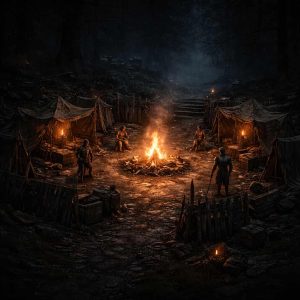
 Diablo II does not look like a game about governance. It has demons, loot, and endless violence. Yet beneath the clicking and chaos sits a clear political vision. Sanctuary is a world where institutions have failed, authority is suspect, and survival depends on local trust rather than grand systems, which is partly why buying D2r items can feel like relying on community trade networks instead of any official system. In that sense, Diablo II feels uncomfortably close to our own moment.
A World Without a State
A functioning state does not rule the world of Sanctuary. There are no courts, no standing armies, no laws that matter beyond the next town. Power has collapsed into fragments. What remains are villages, encampments, and scattered figures trying to hold things together. Governance exists, but only in improvised, fragile forms.
Authority Without Enforcement
Each act begins in a settlement that serves as a temporary center of order. Tristram, Lut Gholein, Kurast’s docks, the Barbarian stronghold. These places are not capitals. They are refugees. Their leaders do not command. They plead, advise, and hope. Authority here is moral rather than institutional. Cain is listened to because he remembers. Jerhyn rules because people still accept him. Qual-Kehk leads because his people trust him in battle.
This is governance stripped to its minimum. No monopoly on violence. No capacity to enforce rules beyond persuasion or personal strength. Legitimacy matters more than structure. When trust disappears, nothing replaces it.
The Failure of Institutions
The most powerful organizations in Diablo II fail spectacularly. The Horadrim, once guardians of order, fracture and fade. The Zakarum Church, meant to guide spiritually, collapses into corruption and madness. These are not just fallen institutions. They are warnings.
The game does not suggest that better leadership would have saved them. It indicates that the concentration of power itself invites decay. Mephisto does not conquer by force alone. He infiltrates belief systems, hollows out rituals, and makes obedience automatic. Governance becomes a tool of domination when it ceases to be accountable.
The Outsider as Problem-Solver
Against this backdrop, the player character operates outside formal authority. You are not elected. You are not appointed. You act because no one else can. Your legitimacy comes from results. Towns accept your help because you deliver safety, not because you hold office.
This is a harsh meritocracy shaped by crisis. But the game does not romanticize it. The hero is transient. You fix problems and move on. Nothing you do rebuilds institutions. Evil returns in different forms. Sanctuary is not saved. It is managed.
Governance as Containment, Not Progress
This distinction matters. Diablo II suggests that in deeply broken systems, governance shifts from long-term planning to constant containment. Stability is not restored. It is postponed.
Even the economy reflects this reality. Gold is abundant and mostly useless. What matters are items, favors, and relationships. Trade is local and practical. Value is contextual. This mirrors societies in which formal systems collapse, and people rely on access, trust, and reputation rather than currency.
Informal Law and Directed Violence
Law, when it exists, is informal. Breaking chests in town is tolerated. Killing monsters is encouraged. Violence is not restrained. It is redirected. Governance here is less about limiting force and more about pointing it at shared threats.
A Cyclical View of Power and Collapse
One of the game’s most revealing features is its cyclical structure. Evil is never permanently defeated. Diablo returns. Baal corrupts again. History repeats. Progress is not linear.
In this frame, governance is not about achieving lasting order. It is about enduring disorder without surrendering entirely. That is a far darker vision than most political theory offers.
Small Acts of Order in a Broken World
Yet the game is not nihilistic. People still gather. They still tell stories. They still help one another. Governance survives at the most minor scale. A healer offering aid. A blacksmith repairing armor. A mercenary fighting beside you because you paid fairly and treated him well.
These micro-acts matter. They show governance not as ideology, but as practice.
Why Diablo II Still Feels Relevant
Diablo II endures because it refuses comforting illusions. It does not promise perfect rule or permanent reform. It shows what happens after systems fail and people keep going anyway. Governance becomes local, fragile, and human.
That lesson lands harder today than it did in 2000. Not because we live in Sanctuary, but because we recognize the shape of it.